The Real Squat-Proof Test: Why the Bend-Over Mirror Check Isn't Enough
Quick Answer: The standing bend-over mirror check doesn’t predict squat-proof performance because it doesn’t replicate the actual fabric stress of a deep squat — weave density thins and gaps most under sustained horizontal stretch across the widest part of the thigh and glute, which standing forward bends don’t fully load. The tests that actually predict real-world performance are the stretch-under-bright-light test (pulling the fabric taut over your fist toward a light source) and the phone-flashlight-behind-the-fabric test while the fabric is stretched, not relaxed.
You did the mirror test before buying. Bent all the way over, had a friend check, everything looked solid. Then you hit a deep squat at the gym under bright ceiling lights and someone mentioned you might want to check your leggings. The mirror test wasn’t wrong, exactly — it just tested the wrong kind of stretch.
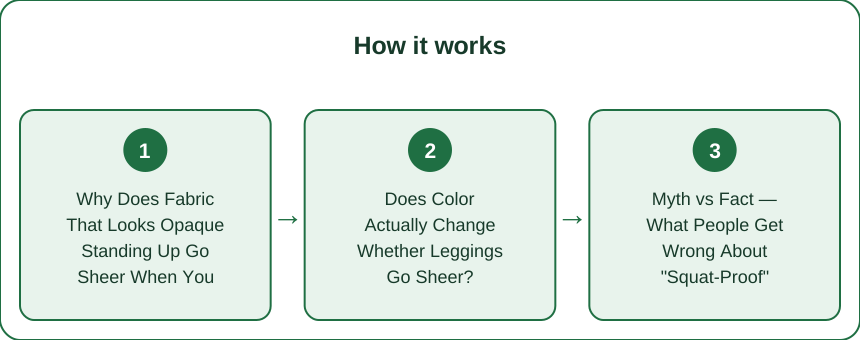
Why Does Fabric That Looks Opaque Standing Up Go Sheer When You Squat?
Leggings fabric is a knit, which means it’s built from interlocking loops of yarn rather than a solid woven sheet. When you stretch a knit, those loops elongate and the gaps between them widen — that’s fundamentally how stretch fabric works, and it’s also exactly what makes it thin out and let more light through the more it’s stretched.
A standing forward bend does stretch the fabric across the glutes and upper thigh, but a deep squat stretches it further and in more directions at once — horizontally across the widest part of the thigh, vertically as the knee bends, and diagonally around the hip crease — all simultaneously, at the point in the fabric that’s usually already under the most tension from fit. That combined, multi-directional stretch thins the fabric more than a single-direction bend does, which is why fabric that reads opaque in a standing bend can go sheer at the bottom of a squat.
Weave (technically knit) density is the underlying variable. A denser knit — more yarn loops per square inch — has less room to gap open under stretch, so it stays more opaque at higher stretch levels. Lower-density knits, often found in cheaper or ultra-lightweight “buttery soft” leggings, have more slack between loops to begin with, so they cross the sheer threshold at a much lower stretch percentage. This is a measurable fabric property (sometimes listed as thread count or GSM, though brands rarely publish knit density directly), which is why price and fabric weight correlate fairly reliably with real squat-proof performance.
Does Color Actually Change Whether Leggings Go Sheer?
Yes, significantly — color affects perceived sheerness independent of the actual fabric gapping, because sheerness is really about contrast between skin tone and fabric, not just how much fabric is stretched. Black and other dark, saturated colors absorb light rather than transmitting it, so even when the knit gaps open under stretch, less light passes through to reveal skin tone underneath — dark colors have real headroom that lighter colors don’t.
Light colors — white, pale gray, light pastels — have almost no margin for error. Because there’s minimal color saturation to begin with, even a small amount of knit-gapping under squat stretch is enough to reveal a visible skin-tone silhouette, especially under bright overhead light that shines directly through the thinned fabric from above. This is why “squat-proof in black” and “squat-proof in white” are functionally different claims about the same garment — a fabric that’s genuinely opaque in black at maximum stretch can still show through in a pastel colorway made from the identical knit.
Mid-tone and heathered colors sit in between, and heathered fabric specifically has a visual advantage: the mixed light-and-dark fiber pattern breaks up the appearance of any thin spots, making minor gapping much less visually obvious than it would be on a solid light color even at the same actual fabric density. If squat-proof performance matters more than color choice, defaulting to black, deep jewel tones, or heathered fabric gives meaningfully more real-world margin than pastels or white.
Myth vs Fact — What People Get Wrong About “Squat-Proof” Testing
Myth: If leggings pass the bend-over test in the dressing room, they’ll pass anywhere. Fact: Dressing room lighting is typically dim and diffuse, which is the least revealing lighting condition for sheerness. Gym lighting is often brighter and more direct, especially near mirrored walls that bounce additional light back onto the fabric — the exact same leggings can perform differently in each setting.
Myth: “Squat-proof” on the label means it’s been tested at maximum stretch. Fact: There’s no industry standard for what “squat-proof” testing means, and some brands apply the label based on fabric weight alone without testing an actual deep squat under bright light. Treat the label as a starting signal, not a guarantee, especially for lighter colorways.
Myth: Thicker leggings are always more squat-proof. Fact: Thickness and knit density aren’t the same thing. A thick but loosely knit fabric can still gap open under stretch, while a thinner, densely knit fabric can outperform it. Weight alone (grams per square meter) is a reasonable proxy but not a perfect one — how tightly the yarn is knit matters just as much.
Myth: A quick glance in a standing mirror is close enough to a real test. Fact: Since sheerness is driven by stretch, not just by fabric per se, any test that doesn’t load the fabric the way a squat does will underestimate the risk. The two tests below are specifically designed to replicate that stretch.
The Two Tests That Actually Predict Squat-Proof Performance
Test 1: The stretch-and-light test. Pull a section of the leggings fabric — ideally from the thigh or seat area, since that’s where squat stress concentrates — taut over your closed fist, stretching it to roughly the same degree it would stretch across your thigh in a deep squat. Hold that stretched fabric up to a bright window or lamp and look for light passing through in a visible pattern. This replicates the actual stretch mechanism far more accurately than a relaxed-fabric visual check, because it’s testing the fabric at the tension level that matters.
Test 2: The phone flashlight test, under stretch. With the fabric still stretched over your fist or a friend’s hand, turn on your phone’s flashlight and hold it directly behind the fabric in a dim room. This is a more sensitive version of the light test — flashlight is more concentrated and directional than ambient light, so it reveals gapping that ambient light might not show. If you can see the outline of fingers clearly through the stretched fabric, the leggings are very likely to show skin tone in a real squat under bright gym lighting.
Do both tests before removing tags, since most retailers won’t accept a return on leggings that show wear from a workout. Combine the results with color awareness — a fabric that’s borderline on the flashlight test in black is a genuine risk in a lighter colorway of the same product line.
FAQ: Squat-Proof Leggings Questions, Answered
Is the bend-over test completely useless?
Not useless, just insufficient on its own — it catches genuinely thin fabric but misses the multi-directional stretch of a deep squat, so it produces false confidence more often than it should.
Do more expensive leggings always pass the flashlight test?
Usually, but not always — price correlates with knit density and fabric weight but isn’t a guarantee, especially with newer or lesser-known brands. Testing directly is more reliable than price alone.
Should I always buy squat-heavy leggings in black?
Not required, but black and dark, saturated colors give meaningfully more margin for error than white or pastels made from the same fabric, so it’s the lower-risk choice if you’re unsure about a specific product’s knit density.
Does fabric go sheer permanently after repeated squats, or only in the moment?
For quality, densely-knit fabric, sheerness during a squat is temporary and the fabric returns to opaque at rest. Fabric that’s already lower-density can develop more permanent thinning over time from repeated stretch and washing, which is part of why squat-proof performance can decline with a garment’s age.
TL;DR:
- Deep squats stretch fabric in more directions at once than a standing bend, which is why the mirror test misses real sheerness risk
- Dark, saturated colors and heathered fabric hide knit-gapping far better than white or pastels made from identical fabric
- The stretch-over-fist test and the stretched-flashlight test both replicate squat stress and are far more reliable than a relaxed visual check
- “Squat-proof” isn’t a standardized label — test before removing tags, especially in lighter colorways
Do both light tests before your first workout in a new pair — it takes thirty seconds and it’s the only real way to know before you’re the one finding out in a crowded gym.
See It in Motion
Seen here: High Waist 8” Yoga Shorts — shop similar styles on bubblelime.com
Keep Reading
This article is for general informational and styling purposes only. Fit, sizing, and product availability may vary.